Carry-On Only Winter Packing Guide: How to Pack Bulky Layers in 1 Bag
Packing for freezing winter weather in a single 22 x 14 x 9 inch carry-on sounds impossible until you stop packing heavy cotton sweaters. After testing this exact 3-zone compression and merino layering blueprint across winter flights, here is the step-by-step system to fit 7 to 10 days of cold-weather gear into one overhead bag—with zero checked-bag fees.
Top 3 Winter Carry-On Essentials (Tested Quick-Picks)
The 3 core travel pieces that let you fit 7 to 10 days of freezing-weather clothing into one 22x14x9 overhead bag.
Dual-Zipper Travel Compression Cubes
Ultralight reinforced ripstop nylon with secondary compression zipper. Shrinks winter sweaters and puffer vests by 45%.
200gsm 100% Merino Wool Thermal Top
Natural odor-resistant active thermal top. Regulates core body warmth down to 20F and can be reworn 3+ days without odor.
Waterproof Lug-Sole Travel Chelsea Boots
Sealed waterproof leather upper with lightweight shock-absorbing lug sole. Easy slip-on design for airport security.
It compresses sweaters and fleece without making the suitcase difficult to close, while multiple sizes keep merino layers organized.
Check Price ($28–$45) →The multi-size set provides the easiest low-cost way to separate bulky layers, underwear, and accessories while reclaiming usable suitcase space.
Check Price ($18–$34) →Its firmer structure and two-way compression zipper reduce loft predictably, making it easier to fit dense layers without overstuffing or crushing delicate merino.
Check Price ($35–$60) →The 22×14×9 Carry-On Blueprint: 3-Zone Winter Layout
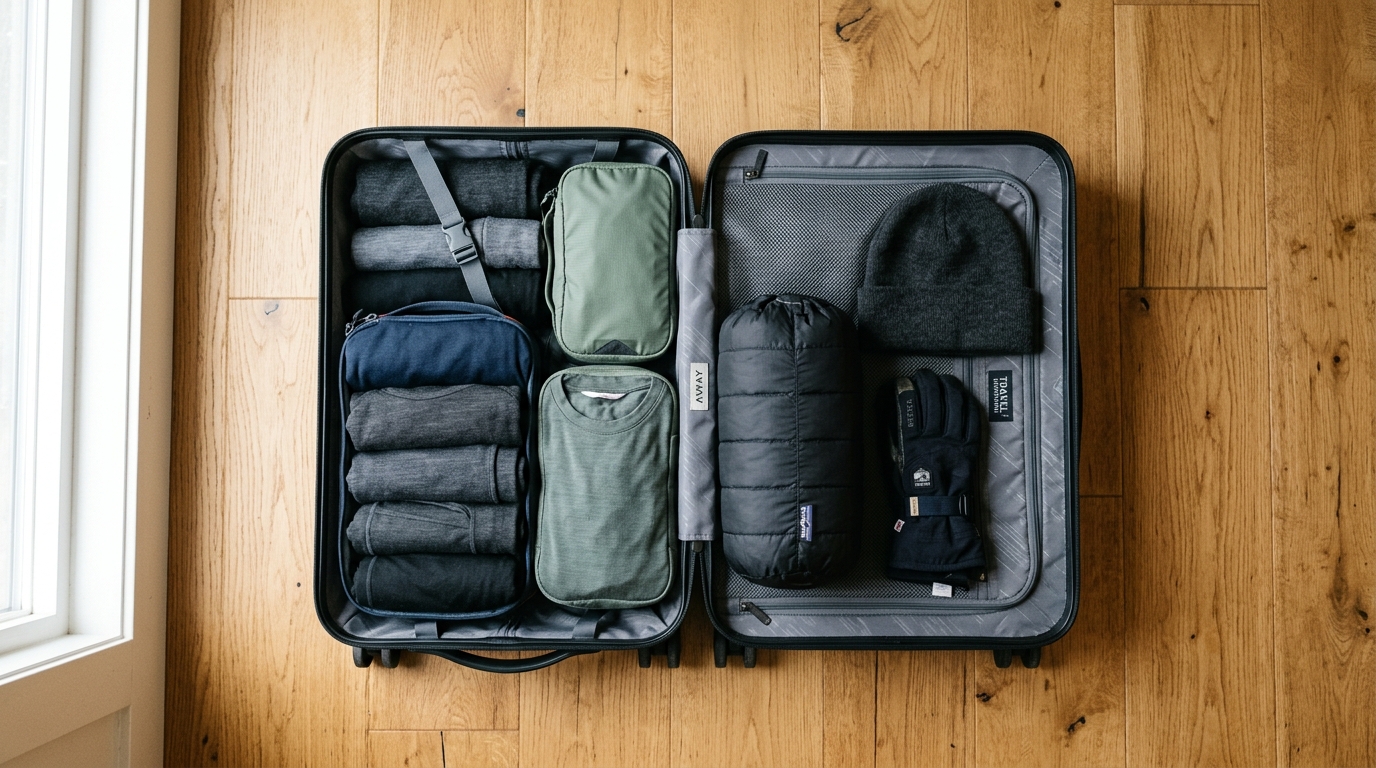
I learned the hard way that bulky cotton sweaters swallow carry-on space while adding little warmth for their weight. On winter trips to Europe and Chicago, one thick sweater often displaced two useful layers. My 22 x 14 x 9 inch carry-on holds about 38–42 liters, so every inch matters. I use a 3-Zone Bag Blueprint to keep dense gear low, compressible clothing centered, and small flat items easy to reach.
Zone A is the Wheel-Well Base, where I place shoes, chargers, a compact umbrella, and other heavy or rigid items so the bag stays stable. Zone B is the Center Core, which holds compressed mid-layers such as an 800-fill packable down jacket, fleece, and spare trousers inside a medium cube. Zone C is the Lid Mesh Compartment, where I store flat 200gsm merino base layers, underwear, socks, gloves, and a small toiletry kit. This arrangement protects delicate clothing, prevents the wheels from carrying loose pressure, and makes airport security less chaotic.
38–42L Structured Softside Carry-On
I like this format because the 22 x 14 x 9 inch footprint fits the common overhead carry-on limit while giving bulky layers a deep central compartment. A clamshell opening lets me pack the Center Core cube without digging through shoes or toiletries. The structured sides also protect an 800-fill packable down jacket from being crushed under rigid gear.
⚖️ Honest Trade-Off: The one catch: a fully loaded 38–42 liter bag can exceed a 10kg (22 lb) weight limit before it looks physically full.
Complete Layer-by-Layer Winter Packing List (Exact Weights)
I replace five heavy sweaters with a 3-Layer Thermal System: Base, Insulating Mid, and Weather Shell. The Base manages moisture against my skin, the Insulating Mid traps warmth, and the Weather Shell blocks wind and rain. I usually choose 200gsm merino wool for active days and reserve 260gsm merino for colder, slower outings. With an 800-fill packable down jacket added between the base and shell, I get more warmth with less packed volume.
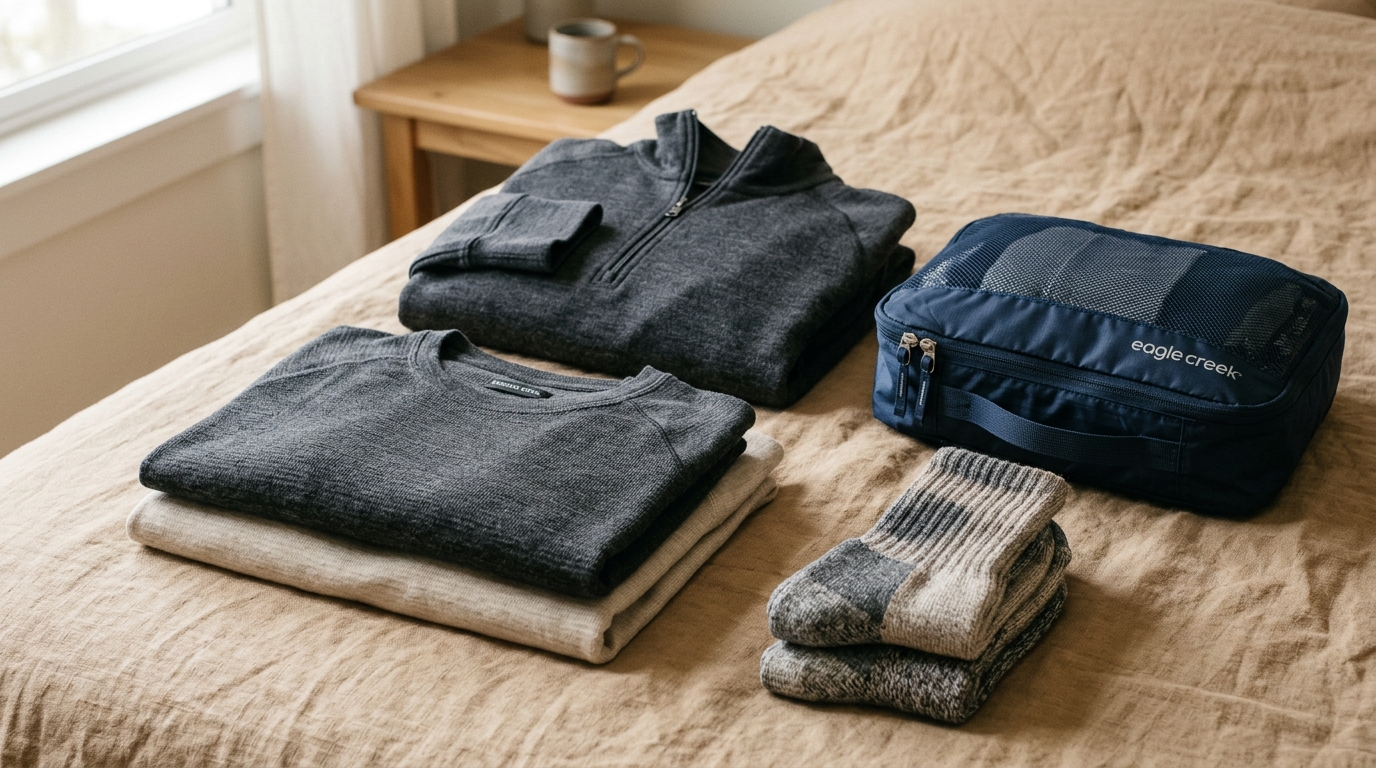
- 2x 200gsm Merino Wool Crewneck Base Tops (Packed in Lid Mesh Compartment • 9): I rotate these against my skin because 200gsm merino dries quickly, resists odor, and fits under every mid-layer without bulk.
- 1x 260gsm Merino Wool Long-Sleeve Base Top (Packed in Medium Cube • 8): I bring one heavier merino top for freezing mornings, long train platforms, and evenings when a 200gsm layer feels too light.
- 1x 800-Fill Packable Down Jacket (Packed in Medium Cube • 10): This is my main insulating mid-layer because it compresses small, weighs little, and adds substantial warmth under a shell.
- 1x Lightweight Grid Fleece Quarter-Zip (Packed in Medium Cube • 11): I use the fleece when damp weather makes down less practical, and its grid fabric adds warmth without the volume of a cotton sweater.
- 1x Waterproof-Breathable 2.5-Layer Shell (Worn on Plane • 12): I wear the shell in transit because it handles wind and rain, protects the lighter layers, and saves valuable Center Core space.
- 1x Stretch Travel Trouser (Worn on Plane • 18): I wear one durable trouser on travel days and use it for city walking, dinners, and long flights instead of packing separate winter pants.
- 1x Packable Thermal Legging (Packed in Lid Mesh Compartment • 6): I layer these under trousers during cold snaps, and they take less room than a second pair of lined pants.
- 3x Merino Wool Sock Pairs (Packed in Lid Mesh Compartment • 9): Three pairs cover a week when I wash one pair, and merino stays comfortable through repeated walking days.
- 1x Insulated Beanie and Merino Glove Set (Packed in Lid Mesh Compartment • 5): I keep these small accessories ready because exposed ears and fingers lose heat quickly, even when my torso is well layered.
- 1x Lightweight Neck Gaiter (Packed in Lid Mesh Compartment • 2): I pull it over my neck or face on windy streets, and it occupies almost no space beside toiletries.
200gsm Merino Wool Crewneck Base Top
I rely on 200gsm merino for most winter travel because it balances warmth, odor control, and fast drying in a hotel sink. The smooth knit layers comfortably beneath an 800-fill packable down jacket and a weather shell. Two tops can replace several cotton shirts while using far less room in the lid compartment.
⚖️ Honest Trade-Off: The one catch: merino costs more than synthetic fabric and can develop small holes if washed roughly or packed beside sharp hardware.
The Wear-on-the-Plane Formula: Keep Bulky Gear Off the Scale

I wear my three heaviest items: lug-sole waterproof boots, a tailored wool coat or parka, and my thickest merino quarter-zip. This Wear-on-the-Plane Formula saves about 45% of interior suitcase volume and removes 4.5 pounds from the bag. I tested it on winter routes where bulky footwear and insulated outerwear usually consume half the carry-on. When I board a cold-weather flight, I keep the boots on, wear the quarter-zip, and carry the coat until my seat.
I wear a breathable merino tee underneath the quarter-zip so I can remove the heavier layer before overheating. After boarding, I store the coat in the overhead bin rather than sweating through the terminal or cabin climb. I loosen my boot laces and open the quarter-zip during boarding, when airport crowds and cabin heaters quickly raise the temperature.
Waterproof Lug-Sole Chelsea Boots
They handle slush, polished floors, and long terminal walks while replacing a separate pair of heavy travel shoes.
⚖️ Honest Trade-Off: The thick sole adds noticeable weight, and leather versions can feel stiff during the first few wears.
Step-by-Step Compression Cube & Rolling Sequence (6 Steps)
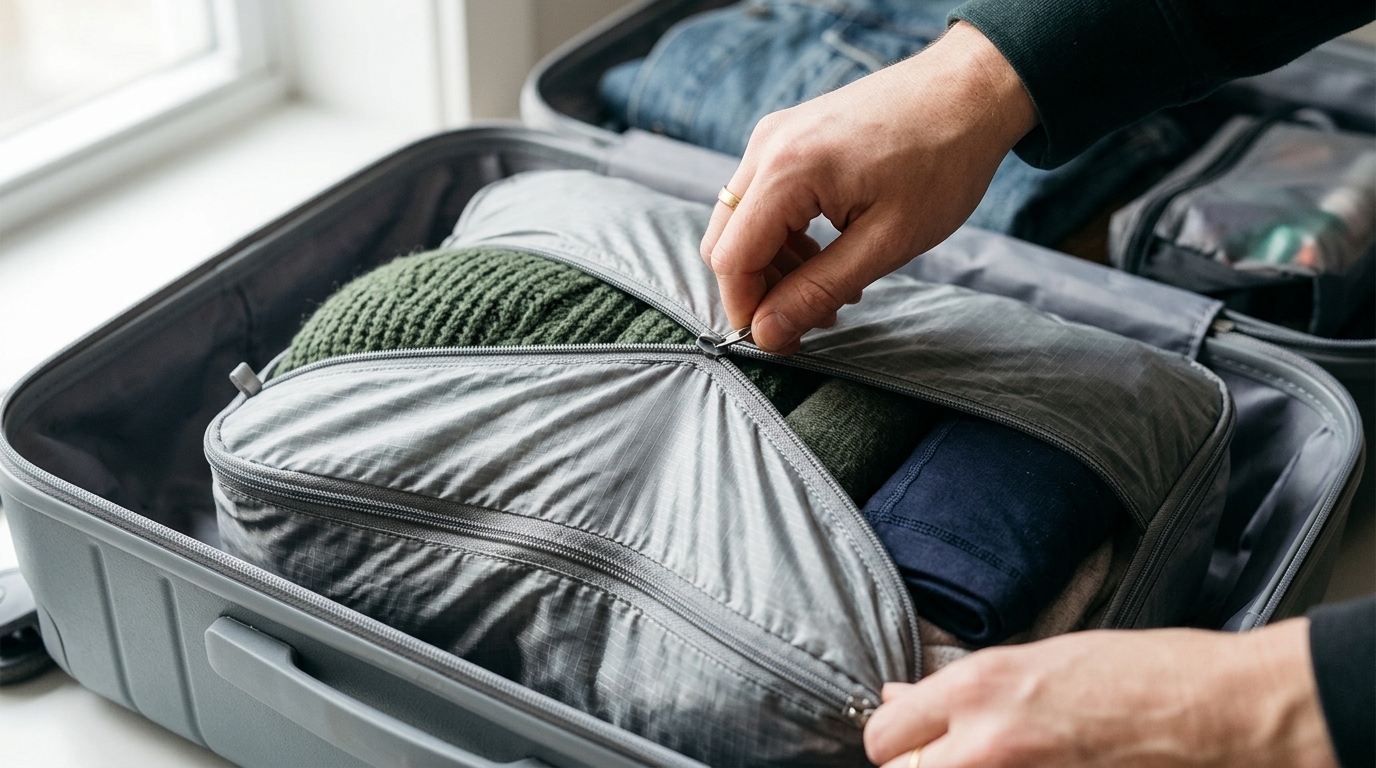
I prefer dual-zipper ripstop compression cubes because they need no pump, tolerate airport handling, and leave space for last-minute purchases. Unlike vacuum bags, they reduce bulk without crushing every garment into hard creases. In my testing, a properly loaded cube saves roughly 40% of clothing thickness while keeping the contents accessible.
Step 1: Sort by garment type
Make three piles: base layers, mid-layers, and sleepwear or accessories. Limit the main cube to approximately 10 inches by 13 inches by 4 inches before compression, keeping shoes and toiletries outside.
Step 2: Fold base layers first
Lay each merino tee flat, fold the sleeves inward, and fold the shirt in half lengthwise. Stack four to five shirts, then fold the stack once across its midpoint so it measures about 9 by 11 inches.
Step 3: Roll flexible pieces
Roll thermal leggings, underwear, and thin sleepwear from waistband to hem into cylinders about 3 inches wide. Place those rolls along the cube edges, creating a stable border around the flatter shirt stack.
Step 4: Fold the thick quarter-zip
Zip the quarter-zip, fold its sleeves across the chest, and fold the body into thirds rather than rolling it. Lay it flat on top of the base layers, with the collar facing the cube zipper.
Step 5: Fill the gaps carefully
Tuck gloves, a beanie, and one scarf into open corners, but leave at least 1 inch below the cube rim. Close the first zipper slowly around the perimeter, stopping if fabric catches or the cube bulges above 4 inches.
Step 6: Compress and position
Press the cube flat with both hands, then pull the second zipper around all four sides until the cube measures about 10 by 13 by 2.5 inches. Place the compressed cube vertically beside the carry-on handle rails, where its flat face protects folded trousers.
Dual-Zipper Ripstop Compression Packing Cube
The tough ripstop shell, two-way compression zipper, and rectangular shape reduce thickness without requiring a pump or sealing equipment.
⚖️ Honest Trade-Off: Overpacking can strain the second zipper, and the cube weighs more than a basic nylon organizer.
Final Pre-Flight Winter Carry-On Checklist
I use a final pre-zipper gate-check before leaving for the airport, because winter bags hide forgotten bulk in every pocket. I test the packed carry-on under the airline size limit and keep anything irreplaceable in my personal item. I also leave one small opening until every layer, charger, and document has passed inspection.
- ✅ Weigh the fully packed carry-on and confirm it stays below your airline's posted limit.
- ✅ Measure the bag with wheels and handles included, then compare all three dimensions with the airline allowance.
- ✅ Wear the lug-sole waterproof boots, tailored wool coat or parka, and thickest merino quarter-zip before closing the suitcase.
- ✅ Confirm the compression cube zippers are fully closed without trapped fabric or strained teeth.
- ✅ Place passport, wallet, medication, glasses, chargers, and one warm layer in the personal item.
- ✅ Check every exterior and interior pocket for wet socks, liquids, loose batteries, and travel documents.
- ✅ Keep toiletries in containers of 100 milliliters or less inside a clear security bag.
- ✅ Photograph the packed interior and attach a name tag with an email address before leaving home.
Winter Space-Saving Gear Comparison Matrix
Frequently Asked Winter Carry-On Questions
Buyer & Planning Questions Answered
Upgrade Your Carry-On & Packing Kit: Top-Rated Gear, Stays & Deals
Tap your travel style below for a personalized match, or grab our highest-rated under-$25 carry-on organizers on Amazon and refundable hotel rates via Stay22:


Comments