25 Most Beautiful Places in France for First-Time Visitors (2026 Guide)
Navigating France as a first-time visitor in 2026 is straightforward thanks to the country's high-speed rail (TGV) network. Major cultural hubs and regional centers—from Paris to Lyon, Bordeaux, Marseille, and Strasbourg—are connected in mere hours, allowing travelers to combine famous monuments with quiet regional countryside without the stress of navigating inner-city car traffic.
Heritage Preservation & Conscientious Travel in France
France's architectural monuments and fragile natural reserves require conscientious stewardship from travelers. When exploring protected areas like Calanques National Park or the Dune du Pilat, stick strictly to marked trails to prevent soil erosion and respect local fire safety restrictions during dry summer months. In historic cathedrals, abbeys, and medieval villages, observe respectful dress standards and quiet zones, support local family-run bistros, and always dispose of litter responsibly at municipal recycling stations.
In This Guide
- Mont Saint-Michel & Tidal Bay
- The Eiffel Tower & Champ de Mars
- Palace of Versailles & The Hall of Mirrors
- Château de Chambord
- Gorges du Verdon & Lake of Sainte-Croix
- Cliffside Village of Rocamadour
- Étretat White Chalk Cliffs & Needle Rock
- Valensole Lavender Plateaux
- Dune du Pilat (Arcachon Bay)
- The Medieval Citadel of Carcassonne
- Colmar's Little Venice (La Petite Venise)
- Saint-Tropez & The French Riviera Peninsula
- Chamonix-Mont-Blanc & Aiguille du Midi
- Calanques National Park & Cassis
- Château de Chenonceau Across the River Cher
- Annecy Old Town & Lake Annecy
- Promenade des Anglais & Castle Hill (Nice)
- Village of Gordes & Sénanque Abbey
- Strasbourg Cathedral & Grande Île
- Pont du Gard Roman Aqueduct
- Saint-Malo Granite Ramparts & Tidal Isles
- Bonifacio White Limestone Cliffs & Citadel
- Claude Monet's House & Gardens at Giverny
- Saint-Paul-de-Vence Medieval Artists' Village
- Sainte-Chapelle & Gothic Stained Glass
Essential Pre-Trip Planning: Health, Power & Transit Preparation
Before setting out across France's regional rail network, three fundamental practical decisions shape your comfort and financial safety. Securing compliant international medical protection and packing the correct electrical adapters prevents costly travel friction before your journey begins.
1. Travel Health & Medical Coverage: France provides exceptional emergency healthcare, but medical treatment, clinic visits, and air ambulance repatriation for non-EEA travelers are billed directly out-of-pocket without private insurance. In addition, travelers visiting on a Schengen visa must present certified proof of at least €30,000 in emergency medical coverage. For standard visa-exempt travelers, a robust policy reimburses non-refundable TGV tickets, missed hotel bookings during train strikes, and delayed luggage.
HelloSafe Travel & Schengen Medical Insurance Comparison
Compares certified Schengen-compliant medical policies and comprehensive cancellation coverage from top international underwriters in minutes.
2. Power Conversion & Device Charging: Electrical outlets across France feature Type E sockets with recessed round pin holes and a protruding top grounding pin operating at 230V / 50Hz. Standard North American prongs cannot insert into these receptacles without a dedicated grounded adapter. Equipping a compact multi-port adapter ensures your laptop, phone, and camera chargers operate reliably in hotels and high-speed TGV seats.
Universal European Travel Plug Adapter (Type C/E for France)
Type E/C grounded adapter with USB-C PD fast ports for charging phones and camera batteries across French hotels and TGV train seats.
France utilizes Type E recessed round-prong sockets with male earth pins.
I may earn a commission if you purchase through this link.3. Portable Power for Long Sightseeing Days: Navigating Paris Metro lines, validating digital SNCF Connect QR train tickets, and shooting hundreds of high-resolution architectural photographs consumes battery life rapidly. Carrying a high-capacity, flight-certified external battery pack eliminates the anxiety of a dead device while exploring remote lavender plateaux or medieval hill towns.
Anker 20,000mAh Portable Charger Power Bank with High-Speed USB-C
20,000mAh capacity provides 4+ full smartphone charges to power all-day GPS navigation, SNCF ticket validation, and photography across long sightseeing days.
Powers smartphone GPS navigation, SNCF ticket apps, and camera recharges.
I may earn a commission if you purchase through this link.Complete 25 Beautiful Places in France Comparison Matrix
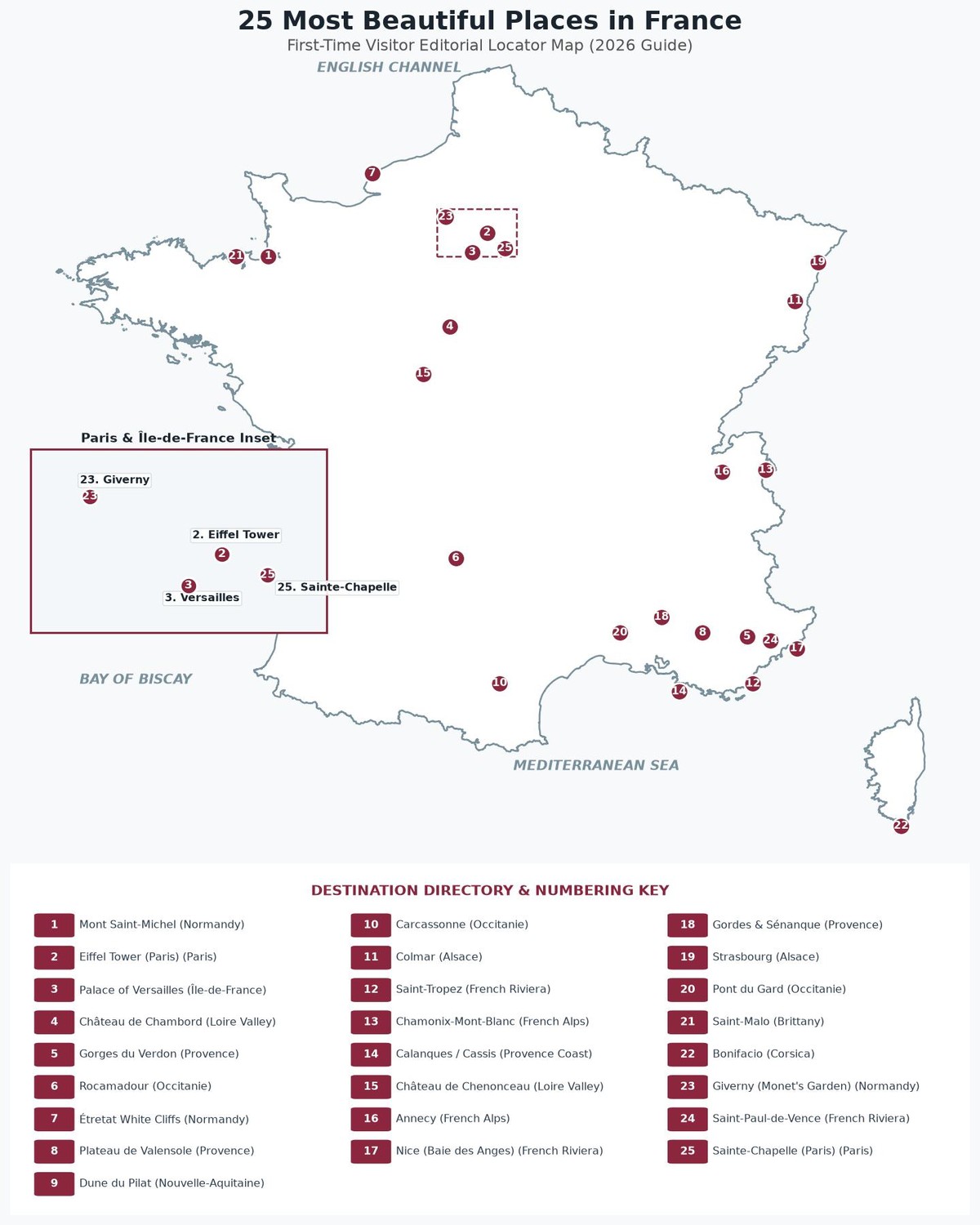
| # | Destination | Region | Landscape Type | Suggested Pacing | Transit Route | Est. Admission |
|---|---|---|---|---|---|---|
| 1 | Mont Saint-Michel & Tidal Bay | Normandy | Tidal Island & Abbey | Half Day to Overnight | TGV to Rennes + Keolis Bus | €13 |
| 2 | The Eiffel Tower & Champ de Mars | Paris (Île-de-France) | City Landmark | 2 to 3 Hours | Metro Line 6 | €18–€35 |
| 3 | Palace of Versailles & The Hall of Mirrors | Versailles (Île-de-France) | Royal Palace & Estate | Full Day | RER C Train from Paris to Versailles Château | €21–€32 |
| 4 | Château de Chambord | Loire Valley (Centre-Val de Loire) | Renaissance Castle | Half Day (3–4 Hours) | TER Train to Blois + Shuttle or Rental Car | €21 / €31 non-EEA |
| 5 | Gorges du Verdon & Lake of Sainte-Croix | Provence-Alpes-Côte d'Azur | River Canyon & Lake | Full Day | Rental Car via D23 Route des Crêtes | Free |
| 6 | Cliffside Village of Rocamadour | Dordogne Valley (Occitanie) | Cliffside Village & Sanctuary | Half Day (3–4 Hours) | TER Train from Brive or Car via D840 | Free |
| 7 | Étretat White Chalk Cliffs & Needle Rock | Normandy (Alabaster Coast) | Chalk Cliffs & Sea Arches | Half Day (3–4 Hours) | TER to Le Havre + Nomad Bus 509 | Free |
| 8 | Valensole Lavender Plateaux | Provence | Lavender Plateau & Fields | Half Day (2–3 Hours) | Rental Car from Manosque or Aix-en-Provence | Free |
| 9 | Dune du Pilat | Nouvelle-Aquitaine (Gironde) | Coastal Sand Dune | 2 to 3 Hours | TER from Bordeaux to Arcachon + Baïa Bus 1 | Free |
| 10 | The Medieval Citadel of Carcassonne | Occitanie (Aude) | Fortified Medieval Citadel | Half Day to Full Day | Direct TGV / TER to Carcassonne Station | Free City |
| 11 | Colmar's Little Venice | Alsace (Grand Est) | Historic Canal Quarter | Half Day (2–3 Hours) | Direct TER from Strasbourg | Free |
| 12 | Saint-Tropez & The French Riviera Peninsula | Côte d'Azur (Var) | Mediterranean Harbor & Peninsula | Full Day | Ferry from Sainte-Maxime or Bus from Saint-Raphaël | Free |
| 13 | Chamonix-Mont-Blanc & Aiguille du Midi | French Alps (Haute-Savoie) | Alpine Summit & Glacier | Full Day | Mont-Blanc Express Train or Bus from Geneva | €78 |
| 14 | Calanques National Park & Cassis | Provence (Bouches-du-Rhône) | Limestone Sea Canyons | Full Day | Metro to Castellane + Bus 21 or TER to Cassis | Free |
| 15 | Château de Chenonceau Across the River Cher | Loire Valley (Indre-et-Loire) | Renaissance River Castle | Half Day (3–4 Hours) | Direct TER from Tours to Chenonceaux | €15.50 |
| 16 | Annecy Old Town & Lake Annecy | Haute-Savoie (Auvergne-Rhône-Alpes) | Alpine Lake & Medieval Old Town | Full Day to Overnight | Direct TER from Lyon | Free |
| 17 | Promenade des Anglais & Castle Hill | Nice (French Riviera) | Mediterranean Seaside Promenade | Half Day (3–4 Hours) | Tramway Line 2 from Nice Airport / Central Station | Free |
| 18 | Village of Gordes & Sénanque Abbey | Luberon (Vaucluse, Provence) | Hilltop Stone Village & Abbey | Half Day (3–4 Hours) | Rental Car from Avignon or Cavaillon | Free Village |
| 19 | Strasbourg Cathedral & Grande Île | Alsace (Grand Est) | Gothic Cathedral & Historic District | Half Day to Full Day | TGV from Paris | Free |
| 20 | Pont du Gard Roman Aqueduct | Occitanie (Gard) | Ancient Roman Aqueduct Bridge | 2 to 3 Hours | Lio Bus 115 from Avignon or Bus 121 from Nîmes | €8 Pass (€9 Parking) |
| 21 | Saint-Malo Granite Ramparts & Tidal Isles | Brittany (Ille-et-Vilaine) | Granite Walled Corsair Port | Half Day to Full Day | Direct TGV from Paris Montparnasse | Free Ramparts & Isles |
| 22 | Bonifacio White Limestone Cliffs & Citadel | Corsica (Corse-du-Sud) | Clifftop Limestone Marine Citadel | Full Day to Overnight | Bus from Figari Airport or Ferry from Sardinia | Free Citadel |
| 23 | Claude Monet's House & Gardens at Giverny | Normandy (Eure) | Artist House & Historic Gardens | Half Day (3–4 Hours) | TER from Paris Gare Saint-Lazare to Vernon + Shuttle | €13 |
| 24 | Saint-Paul-de-Vence Medieval Artists' Village | Côte d'Azur (Alpes-Maritimes) | Hilltop Walled Artists' Village | Half Day (3–4 Hours) | Bus 655 from Cagnes-sur-Mer Station | Free Village & Walls |
| 25 | Sainte-Chapelle & Gothic Stained Glass | Paris (Île-de-France) | Gothic Royal Chapel | 1 to 2 Hours | Metro Line 4 | €22 (€16 EEA) |
* Note: Table reflects general adult admission guidelines; verify current seasonal opening times and advance reservation details directly on official monument portals.
1. Mont Saint-Michel & Tidal Bay
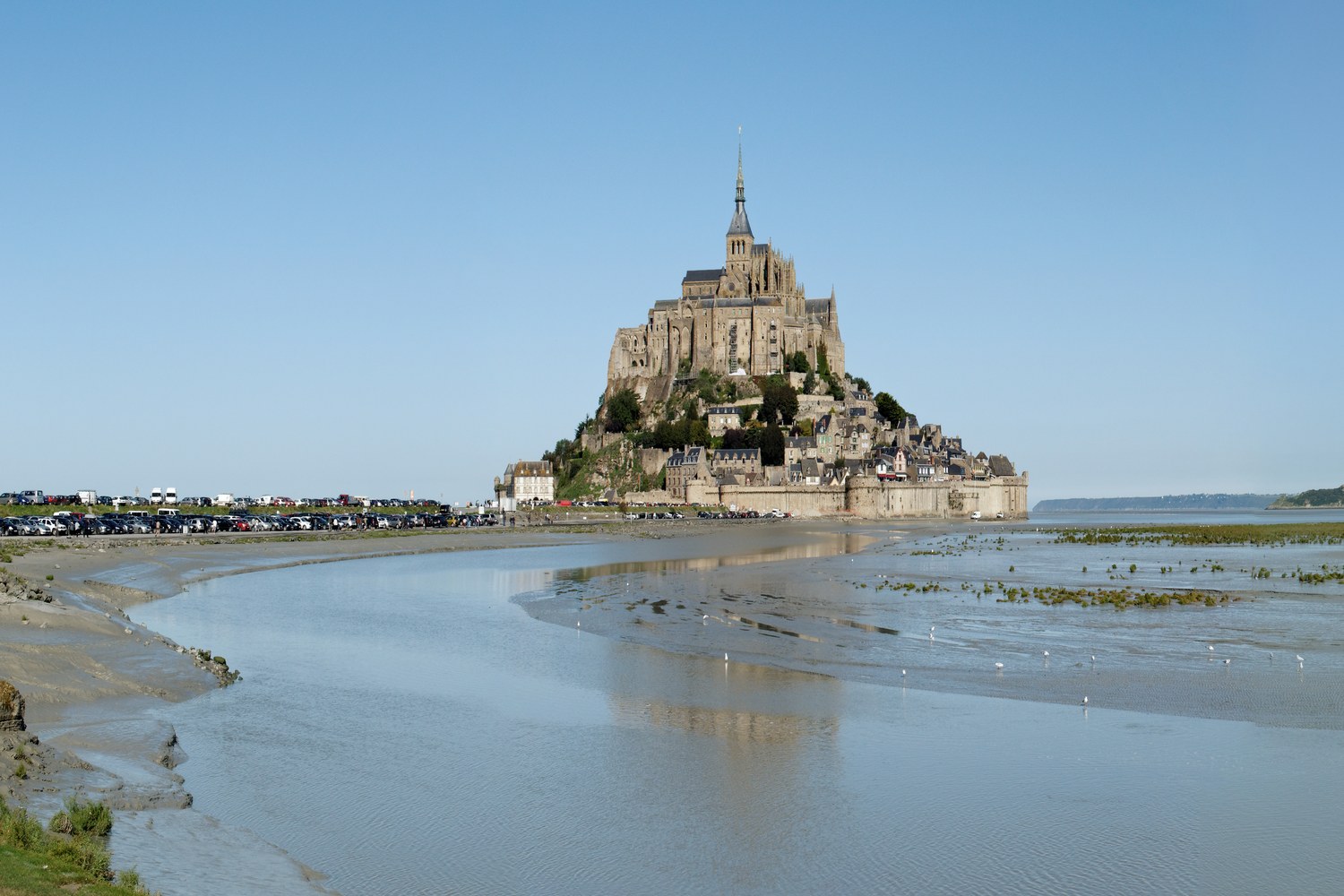
Normandy's tidal bay cradles Mont Saint-Michel, a fortified granite island and 10th-century Benedictine abbey shaped by the most dramatic tidal swings in continental Europe.
Approaching Mont Saint-Michel across the pedestrian causeway reveals the full scale of the historic monument. The Romanesque-Gothic abbey crowns a granite pyramid rising eighty meters above the bay, its slender spires catching the Atlantic morning light. At high tide, water surges across the salt marshes, temporarily isolating the mount as an island.
Wandering the narrow cobblestone ramparts along the Grand Rue early in the morning allows you to explore before large tour groups arrive. Climbing the 350 stone steps to the Abbey cloister rewards travelers with panoramic views across the shifting sandbanks and shallow tidal pools of the Couesnon River.
Mont Saint-Michel Guided Day Trip with Priority Abbey Admission
Includes roundtrip air-conditioned coach transit from Paris, skip-the-line abbey entrance, and expert historical commentary across the medieval ramparts.
Solves the transit puzzle for travelers without a rental car.
I may earn a commission if you book through this link.2. The Eiffel Tower & Champ de Mars
Gustave Eiffel's 330-meter wrought-iron tower has defined the Parisian skyline since the 1889 Exposition Universelle, serving as the primary orientation point for first-time visitors.
Erected for the 1889 Exposition Universelle, the Eiffel Tower showcases late-19th-century French industrial engineering. The open lawns of the Champ de Mars provide a classic vantage point to admire the tower's open-lattice wrought-iron framework against Parisian skies, while the elevated Trocadéro terrace across the river offers an unobstructed framing for photography.
For an active perspective, climb the stairs to the second floor to inspect the ironwork and historic hydraulic elevator mechanisms up close before boarding the summit lift. As dusk falls, the tower sparkles with twenty thousand golden lights for five minutes on the hour, illuminating the Seine bridges below.
Eiffel Tower Summit Priority Access & Guided Architecture Tour
Provides elevator access up to the summit with host escort through security checkpoints and panoramic architectural commentary.
Secures reserved summit admission when official box office slots are fully sold out.
I may earn a commission if you book through this link.3. Palace of Versailles & The Hall of Mirrors
Louis XIV transformed a modest royal hunting lodge into the political epicenter of France at Versailles, creating an expansive royal estate of roughly 787 hectares (1,945 acres) with approximately 2,300 rooms.
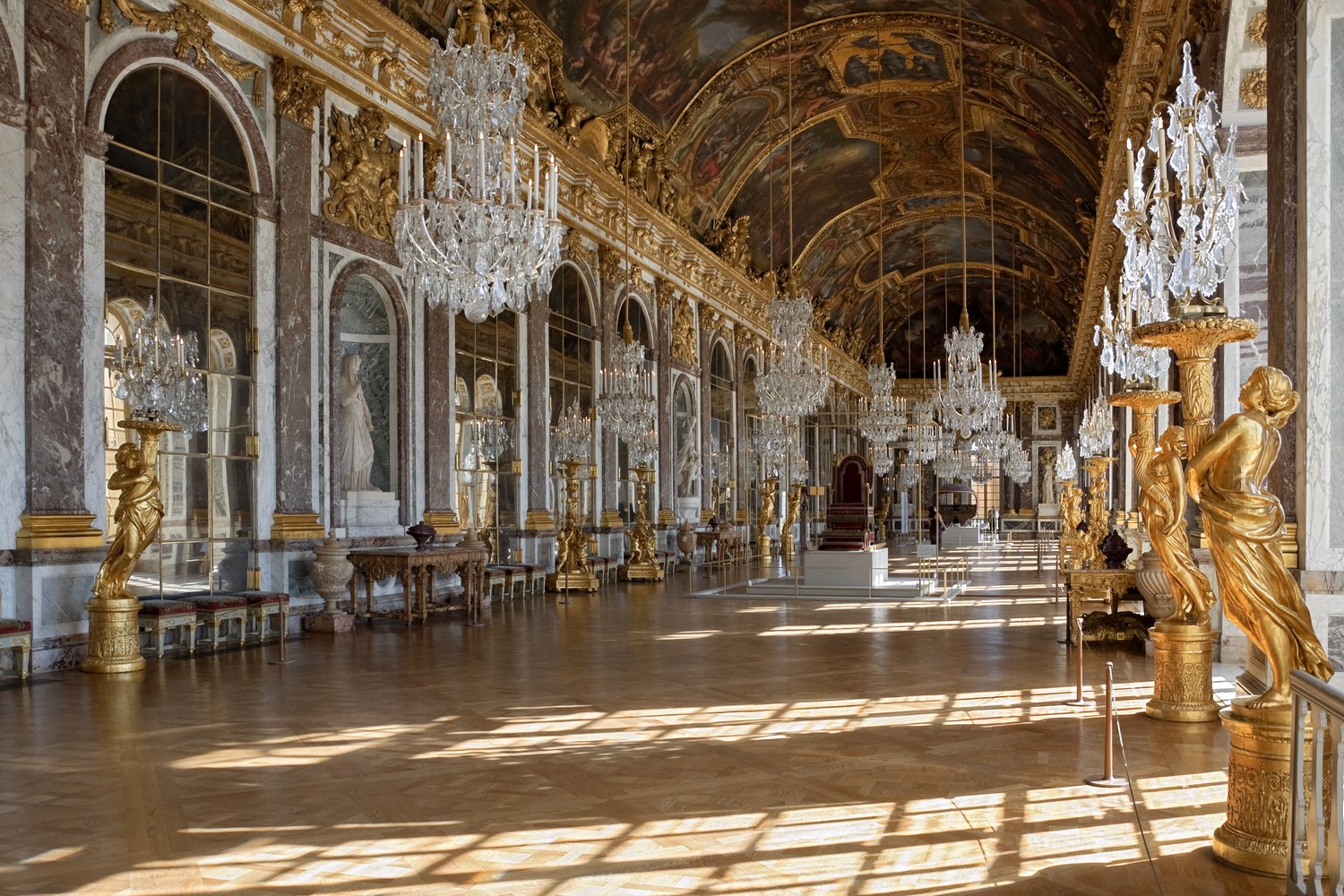
French classical baroque architecture reaches its zenith inside the State Apartments. Seventeen monumental mirrored arches define the centerpiece Hall of Mirrors (Galerie des Glaces), capturing natural daylight that streams across views of the Grand Canal.
Covering 77 hectares, the formal gardens designed by André Le Nôtre feature classical fountains, sculpted hedges, marble statues, and the Grand Trianon. Renting a bicycle or electric cart allows visitors to easily reach the Queen's Hamlet (Hameau de la Reine), Marie Antoinette's preserved rustic farm retreat.
Palace of Versailles Guided Tour with Passport Access & Transport
Skip-the-line State Apartments entry, guided Hall of Mirrors exploration, musical gardens passport, and hassle-free transit from central Paris.
Includes central Paris coach transit, skip-the-line State Apartments, and Musical Gardens.
I may earn a commission if you book through this link.4. Château de Chambord
King Francis I commissioned Chambord in 1519 as a monumental hunting lodge, making it the largest château in the Loire Valley, set within a 13,000-acre walled forested park.
Chambord blends French medieval castle architecture with Italian Renaissance forms. Its central architectural marvel is the open double-helix staircase—widely attributed to Leonardo da Vinci's conceptual designs—where two intertwined stone spirals allow two people to ascend and descend simultaneously without ever crossing paths.
Climbing to the rooftop Italian terrace provides an up-close look at hundreds of ornate chimneys, turrets, and cupolas overlooking the surrounding game forest. Northern moat waters reflect the formal French gardens and the sculpted limestone facade in still mirror pools.
5. Gorges du Verdon & Lake of Sainte-Croix
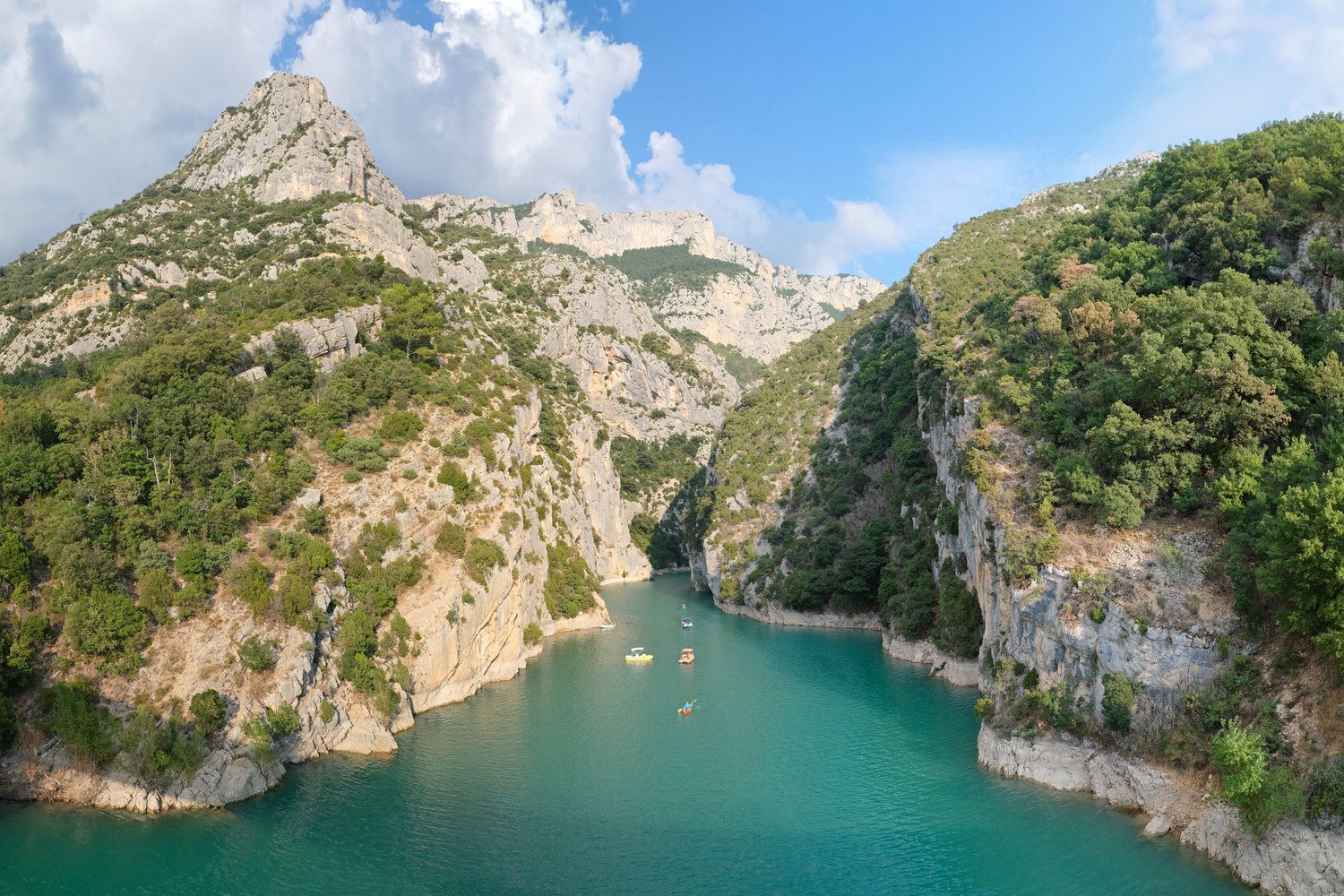
The Verdon River cuts a 25-kilometer canyon through the limestone plateaux of Haute-Provence, dropping up to 700 meters into turquoise waters before opening into the Lake of Sainte-Croix.
Known as France's Grand Canyon, the Gorges du Verdon features sheer limestone precipices cut by the rushing river. Microscopic algae and fine suspended limestone particles reflecting sunlight through clear alpine water produce the river's distinctive turquoise-emerald hue.
Renting an electric boat, kayak, or pedal boat from the Pont du Galetas bridge lets you glide directly into the canyon mouth beneath soaring vertical rock faces. Driving the scenic Route des Crêtes (D23) along the canyon rim offers elevated lookouts where Griffon vultures ride thermal updrafts.
Gorges du Verdon Canyon & Lake of Sainte-Croix Full-Day Excursion
Seamless mountain transit through canyon rim viewpoints with boat rental time on the turquoise waters of Lake Sainte-Croix.
Navigates narrow mountain gorge switchbacks with dedicated lake boat rental time.
I may earn a commission if you book through this link.6. Cliffside Village of Rocamadour
Medieval sanctuaries and stone houses cling directly to a sheer 120-meter limestone cliff above the Alzou river canyon in Rocamadour, welcoming pilgrims along the Camino de Santiago since the 12th century.
Pilgrims navigate a multi-tiered vertical layout: merchant stalls along the Rue de la Couronnerie, 216 stone steps up the Grand Escalier, and a cluster of seven sanctuaries carved directly into the rock face.
Inside the Chapelle Notre-Dame rests the 12th-century walnut Black Virgin statue (Vierge Noire). Outside in the cliff face near Chapelle Notre-Dame, the rock was historically renowned for Durandal, the legendary iron sword wedged into the stone. Upper ramparts atop the castle provide panoramic views over slate rooftops and the Alzou gorge below.
7. Étretat White Chalk Cliffs & Needle Rock
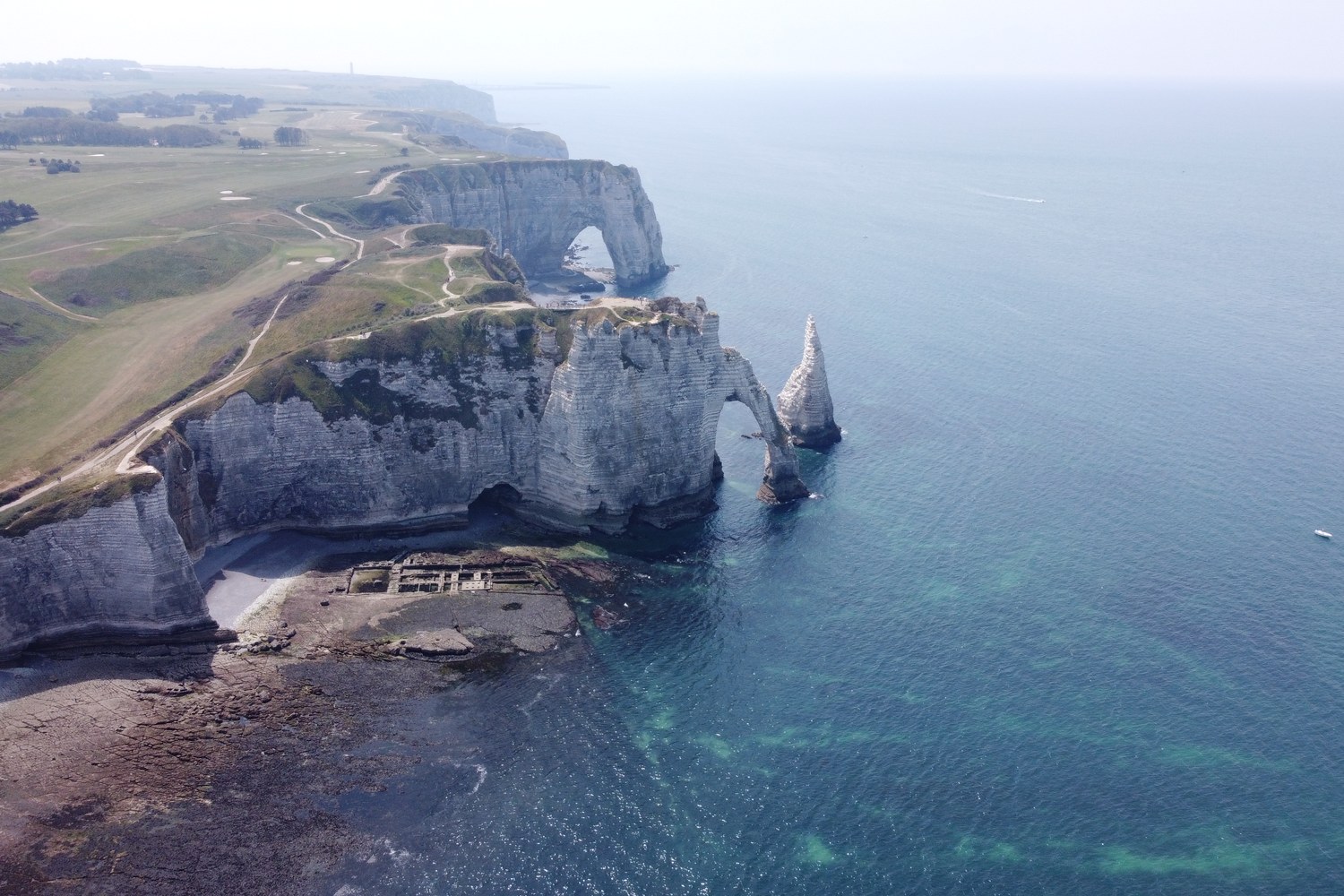
White chalk cliffs and natural sea arches plunge into the English Channel along Normandy's Alabaster Coast at Étretat, where dramatic coastal scenery has drawn landscape painters since the 1860s.
These towering geological formations contrast sharply with azure waters and smooth pebble beaches below, shaped by centuries of English Channel wave action against the soft limestone bedrock.
Hiking the marked GR21 coastal trail atop the Falaise d'Aval leads to views of the iconic Porte d'Aval arch and the 70-meter freestanding chalk needle (L'Aiguille Creuse). Across the bay, the Falaise d'Amont offers views back toward the historic clifftop Chapelle Notre-Dame-de-la-Garde.
8. Valensole Lavender Plateaux
The Plateau de Valensole stretches across 800 square kilometers between the Verdon gorge and the Durance valley, anchoring the agricultural heart of Provençal lavender cultivation.
Each summer, parallel purple rows of lavandin and fine lavender stretch toward distant alpine ridges, broken only by rustic stone shepherd huts (bories) and golden wheat fields.
The blooming window spans from late June through mid-July, right before harvest begins. Driving the scenic D8 and D6 routes reveals traditional distilleries like Lavandes Angelvin, where travelers can observe essential oil steam distillation and sample lavender honey.
9. Dune du Pilat (Arcachon Bay)
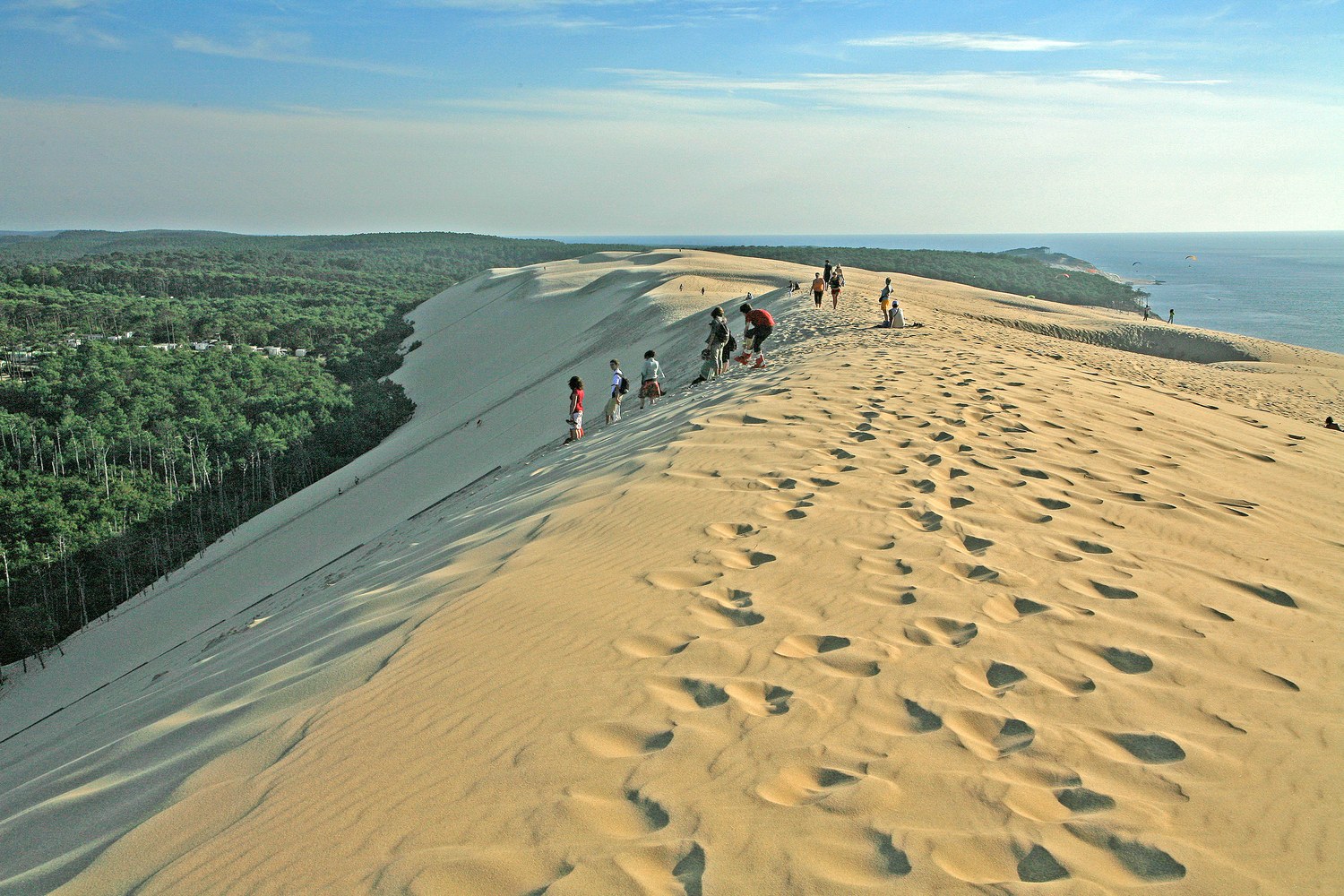
Europe's highest sand dune, the Dune du Pilat, is a dynamic coastal landform that currently reaches approximately 101 meters high between maritime pine forests and the Atlantic entrance to Arcachon Bay.
Recent geological surveys measure the moving dune at roughly 2.9 kilometers in length and 616 meters in width, containing an estimated sixty million cubic meters of quartz sand. Standing on its ridge, visitors take in a striking geographic contrast: dense maritime pine canopies on one side and open Atlantic breakers over the Banc d'Arguin sandbanks on the other.
Between April and November, a temporary wooden staircase is installed on the forest slope to ease the initial climb up the thirty-degree sand face. The summit offers an open vantage point to watch paragliders ride ocean updrafts as the sun sets over the water.
10. The Medieval Citadel of Carcassonne
Double curtain walls spanning three kilometers and 52 stone watchtowers defend Carcassonne, France's largest medieval fortified citadel.
Restored in the 19th century by architect Eugène Viollet-le-Duc, the hilltop fortress features outer and inner defensive ramparts (the Lices), drawbridges, and conical slate turrets overlooking the River Aude.
Walking the cobblestone lanes of the inner town leads to the Basilica of Saints Nazarius and Celsus with its 13th-century stained glass, and the Château Comtal museum where visitors can walk along the upper battlements.
11. Colmar's Little Venice (La Petite Venise)
Canals of the River Lauch wind through Colmar's La Petite Venise district in southern Alsace, bordered by preserved 16th- and 17th-century half-timbered houses painted in traditional pastel shades.
Colmar showcases a distinctive architectural style where German timber-framing blends with French Renaissance detailing. In La Petite Venise, medieval butchers, tanners, and winemakers transported goods along the narrow waterways.
Strolling past the Quai de la Poissonnerie and Pont Saint-Pierre leads toward the Unterlinden Museum, home to Matthias Grünewald's 16th-century Isenheim Altarpiece and historic Alsatian religious art. Electric boat tours glide beneath low stone footbridges, offering serene reflections of half-timbered gables from water level.
12. Saint-Tropez & The French Riviera Peninsula
Sheltered along the Var coastline, the Saint-Tropez peninsula balances a pastel fishing harbor with rugged Mediterranean coastal trails.
Luminous Mediterranean light first attracted Post-Impressionist painters like Paul Signac to Saint-Tropez. Today, historic café terraces line the Old Port (Vieux Port), facing wooden fishing boats alongside modern luxury yachts.
Winding along rocky headlands, the Sentier du Littoral coastal footpath wraps around the peninsula past Cap Camarat and the pine-fringed coves of Plage des Salins. In the village, a short climb to the 17th-century Citadel provides panoramic views over the Gulf of Saint-Tropez and the Maures mountains.
Saint-Tropez Coastal Ferry & Riviera Scenic Boat Cruise
Bypasses heavy peninsula summer traffic jams via a scenic Mediterranean sea cruise directly to Saint-Tropez harbor.
Bypasses peninsula traffic congestion via a scenic Mediterranean boat arrival.
I may earn a commission if you book through this link.13. Chamonix-Mont-Blanc & Aiguille du Midi
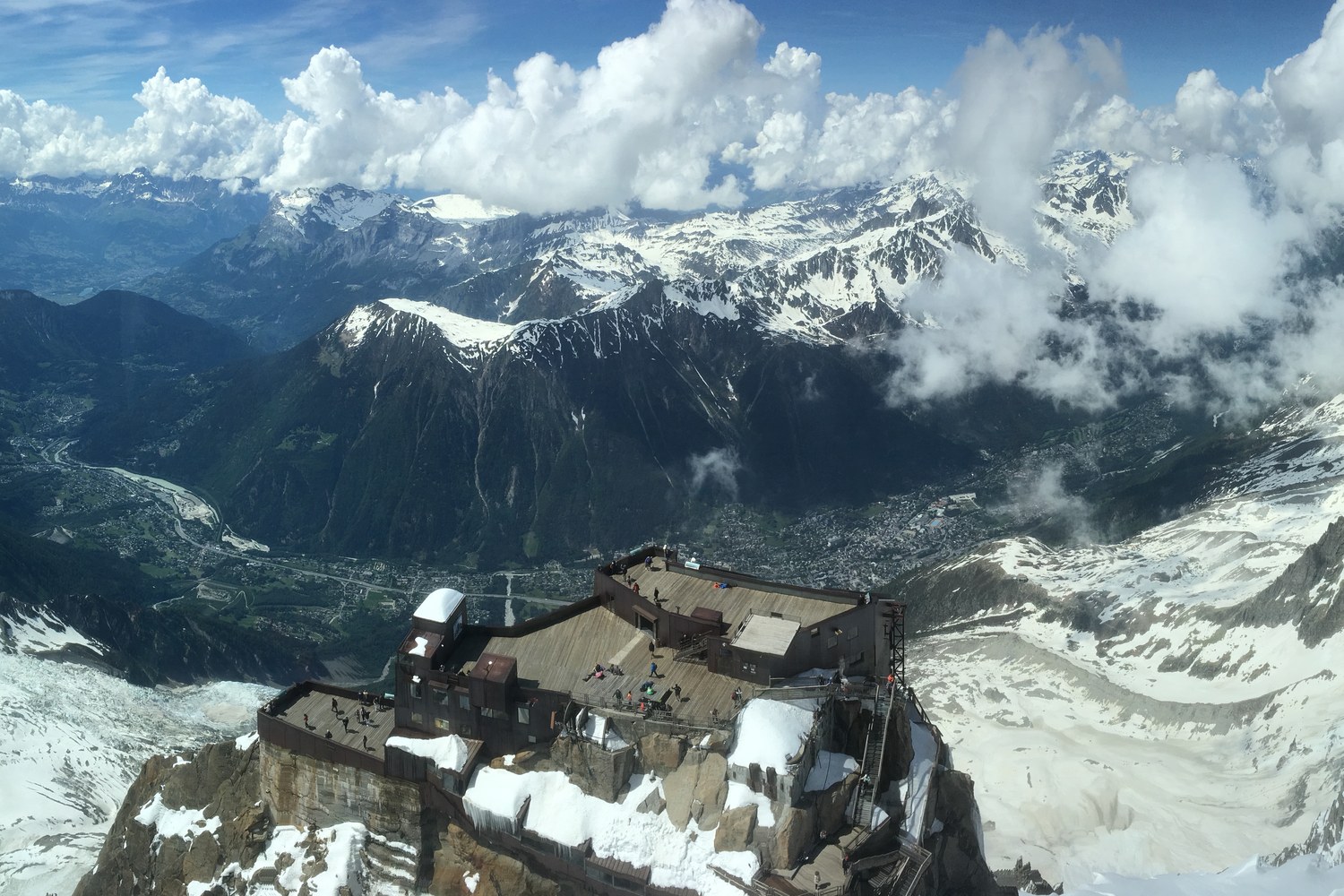
Beneath the soaring Mont Blanc massif (4,807 meters), Chamonix occupies a deep, glacier-carved alpine valley that serves as an international center for high-altitude mountaineering and trail exploration.
The Aiguille du Midi cable car lifts travelers 2,800 vertical meters in twenty minutes from the valley floor to a granite summit at 3,842 meters, offering direct views of Mont Blanc's summit ridge and the Bossons glacier.
At the summit, visitors can step inside the 'Step into the Void'—a transparent glass cube suspended over a 1,000-meter drop. Across the valley, the historic red Montenvers cogwheel train ascends to the Mer de Glace glacier and its carved ice cave gallery.
Chamonix Mont-Blanc & Aiguille du Midi Cable Car Excursion
Includes multi-pass cable car ascent to the 3,842m Aiguille du Midi peak terrace plus the transparent glass skywalk with Mont Blanc panoramas.
Secures peak terrace cable car reservations plus glass skywalk admission.
I may earn a commission if you book through this link.14. Calanques National Park & Cassis
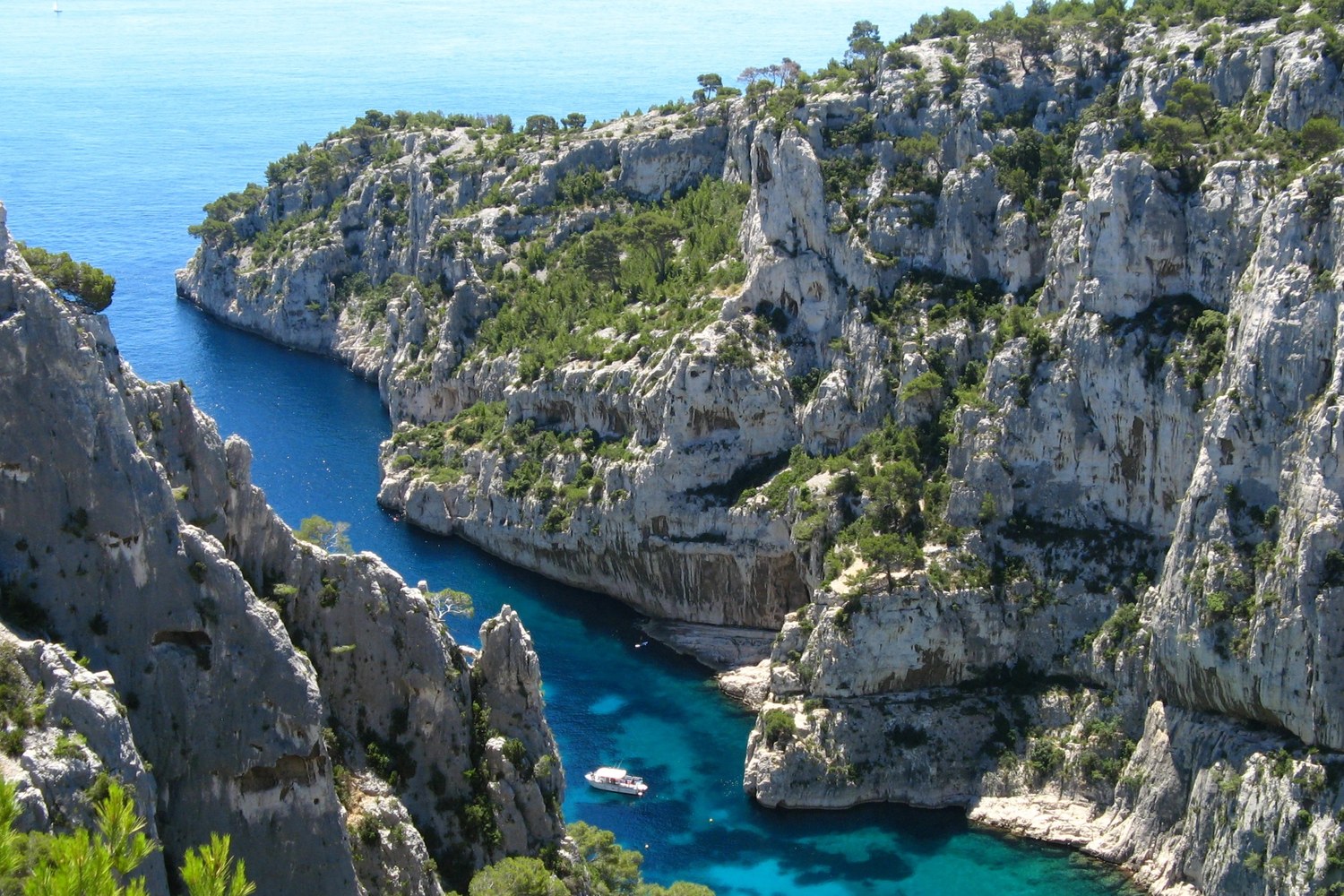
Calanques National Park spans the rugged coastal boundary between Marseille and Cassis, where steep white limestone canyons plunge directly into turquoise Mediterranean inlets.
The park protects unique marine inlets (calanques) carved into vertical Urgonian limestone and fringed by wind-sculpted Aleppo pines. Calanque de Port-Miou, Calanque de Port-Pin, and Calanque d'En-Vau each offer clear, sheltered swimming waters.
Hikers can follow marked coastal trails departing from Cassis harbor, while visitors seeking a relaxing overview can take passenger sightseeing boats from Cassis to view the towering sea cliffs directly from the water.
15. Château de Chenonceau Across the River Cher
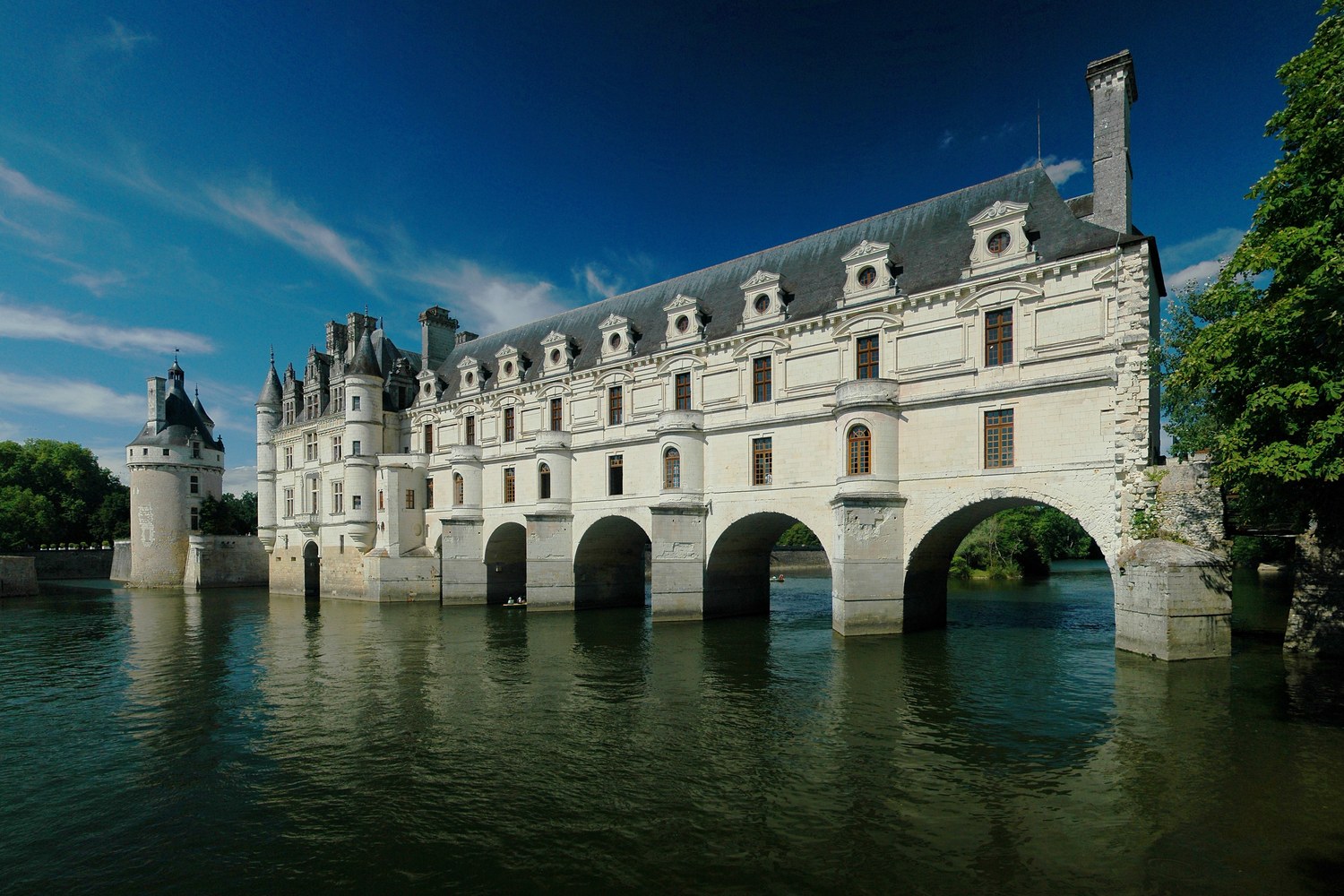
Five stone arches carry the Château de Chenonceau directly across the River Cher, forming a renowned Renaissance gallery bridge bordered by manicured riverside formal gardens.
Shaped by historical women including Diane de Poitiers and Catherine de' Medici, Chenonceau is an architectural highlight of the Loire Valley. Its two-story gallery spans the Cher, creating crisp reflections across the water's surface.
Interior rooms feature preserved Renaissance fireplaces, Flemish tapestries, and paintings by Rubens and Tintoretto. Outside, formal parterres on either side of the château showcase boxwood hedges and seasonal rose plantings.
Loire Valley Castles Day Trip: Château de Chenonceau & Chambord
Efficient full-day tour combining the arched river bridge of Chenonceau and Leonardo da Vinci's double-helix staircase at Chambord with wine tasting.
Pairs both marquee Loire Valley châteaux in a single seamless day from Paris.
I may earn a commission if you book through this link.16. Annecy Old Town & Lake Annecy
Limestone summits of the French Prealps enclose Lake Annecy, whose clear mountain waters border a pastel medieval old town crisscrossed by narrow canals.
Fed by protected mountain springs, Lake Annecy features clear waters that shift from emerald to turquoise. The historic Old Town (Vieille Ville) features arcaded stone walkways, flower-lined canal railings, and the 12th-century Palais de l'Île fortress occupying a mid-canal island.
Walking across the Pont des Amours leads to the lakeside Jardins de l'Europe, while a flat 40-kilometer paved cycle path hugs the western lake shore beneath alpine cliffs.
17. Promenade des Anglais & Castle Hill (Nice)
Nice's palm-lined Promenade des Anglais extends seven kilometers along the Baie des Anges, bordered by grand Belle Époque facades and overlooked by the wooded terraces of Castle Hill.
Constructed in the 1820s as a winter seaside esplanade, the Promenade des Anglais serves as the focal point of Nice's coastal life. The Mediterranean waters border smooth grey pebble beaches, framed by landmark hotels like the historic Le Negresco.
Just behind the waterfront lies Old Nice and the morning Cours Saleya market, where stalls sell flowers, local produce, and hot, crispy socca (chickpea flatbread). From there, ascending Castle Hill (Colline du Château) via stone stairs or the free public elevator leads to shaded waterfall gardens and panoramic terraces overlooking Port Lympia.
18. Village of Gordes & Sénanque Abbey
Golden dry-stone architecture tiers along a steep promontory in Gordes, crowned by a Renaissance fortress and surrounded by Luberon olive groves.
Steep calade stone alleys wind through the compact upper village past artisan workshops and vaulted passageways that long inspired painters like Marc Chagall.
Four kilometers north in a secluded canyon sits the 12th-century Cistercian Sénanque Abbey. Monks here cultivate fragrant lavender rows that bloom violet across the valley floor each July.
Gordes & Luberon Hilltop Villages Day Tour from Avignon or Aix
Minivan tour navigating narrow Luberon roads to Gordes viewpoint, Roussillon ochre cliffs, and Sénanque Abbey lavender fields.
Minivan tour connecting Gordes, Sénanque Abbey, and Roussillon ochre cliffs.
I may earn a commission if you book through this link.19. Strasbourg Cathedral & Grande Île
Reddish-pink Vosges sandstone defines Strasbourg's Gothic cathedral, a historic monument with a 142-meter spire that anchors the city's UNESCO-listed Grande Île river district.
The cathedral features a single 142-meter spire and an intricate western rose window carved like stone lace. Inside, the 16th-century astronomical clock features moving mechanical apostles that parade each day at 12:30 PM.
Encircled by arms of the River Ill, the historic Grande Île features the Petite France quarter, where 16th-century timber-framed tanners' homes with steep roofs line peaceful canals alongside the Vauban Barrage dam.
20. Pont du Gard Roman Aqueduct
This ancient three-tiered limestone aqueduct bridge spans 49 meters above the Gardon river canyon, constructed in the 1st century AD to carry spring water to Nîmes as the tallest surviving Roman aqueduct in the world.
The aqueduct bridge was built without mortar using precisely cut shelly limestone blocks weighing up to six tons each, standing intact across two millennia of Mediterranean floods.
Visitors can walk across the lower tier to examine the massive Roman stone arches up close, then follow shaded hillside footpaths up either bank through Mediterranean scrubland to elevated viewpoints overlooking the river canyon.
21. Saint-Malo Granite Ramparts & Tidal Isles
Brittany's Emerald Coast terminates at Saint-Malo, a historic granite citadel completely encircled by intact defensive ramparts facing open ocean waters.
Saint-Malo was historically famous as a fortified corsair (privateer) port. Rebuilt with stone-by-stone fidelity after World War II, its massive grey granite battlements and deep-set wooden wave-breaker pilings have stood against North Atlantic gales for centuries.
Walking the continuous two-kilometer loop on top of the ramparts offers unobstructed views of waves crashing against coastal rocks. At low tide, the sandy seabed opens up, allowing travelers to walk across to the 17th-century fortress of Fort National and the tidal islet of Île du Grand Bé, where author Chateaubriand is buried.

22. Bonifacio White Limestone Cliffs & Citadel
At the southern tip of Corsica, Bonifacio sits atop 70-meter white limestone cliffs sculpted by Mediterranean winds, overlooking the Strait of Bonifacio toward Sardinia.
The citadel occupies a dramatic natural cliff edge where centuries of wave action have undercut the limestone foundation, leaving stone houses appearing suspended directly over the water.
A major highlight is descending the King of Aragon's Staircase (Escalier du Roi d'Aragon)—187 steep steps carved into the sheer cliff face at a 45-degree angle. Local passenger boats cruise beneath the cliff caverns to reveal sea grottoes and hidden coves.
23. Claude Monet's House & Gardens at Giverny
Claude Monet lived and painted for 43 years in the village of Giverny along the Seine, where his preserved home and gardens showcase the living landscapes that inspired Impressionist masterpieces.
Monet's estate comprises two distinct areas: the Clos Normand floral garden overflowing with roses, irises, and poppies, and the restored pink plaster home showcasing his prized collection of Japanese woodblock prints.
Across the road, the Water Garden features the iconic green wooden Japanese bridge, weeping willows, bamboo groves, and lily basins that served as Monet's living studio for his famous Nymphéas series.
24. Saint-Paul-de-Vence Medieval Artists' Village
Sixteenth-century stone ramparts encircle Saint-Paul-de-Vence above the Côte d'Azur hills, preserving a pedestrian village that has drawn painters and sculptors since the 1920s.
Perched between the Mediterranean and the Maritime Alps, Saint-Paul-de-Vence preserves narrow cobblestone alleys, stone fountain plazas, and historic ateliers that once welcomed Marc Chagall and Joan Miró.
Walking the complete perimeter of the Renaissance ramparts offers views over surrounding olive groves. Nearby in the pine woods sits the renowned Maeght Foundation (Fondation Maeght), displaying modern sculpture gardens by Alberto Giacometti and Miró.
25. Sainte-Chapelle & Gothic Stained Glass
Commissioned by King Louis IX in the 1240s to house sacred Christian relics, Sainte-Chapelle on the Île de la Cité stands as a pinnacle of Rayonnant Gothic design.
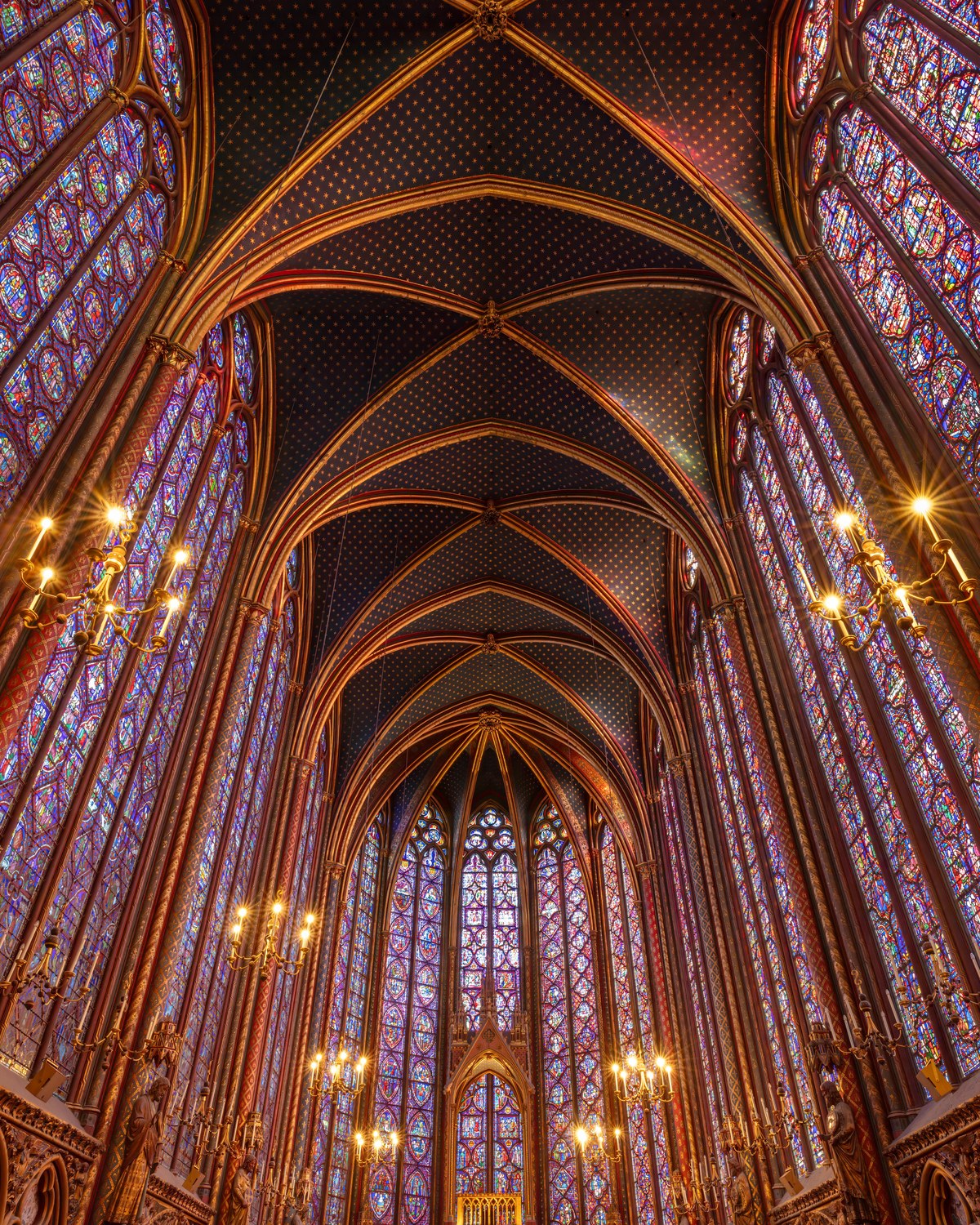
The upper chapel features fifteen soaring stained-glass windows rising nearly fifty feet high, replacing exterior load-bearing walls with 1,113 luminous panels depicting biblical narratives.
Strong sunlight fills the sanctuary with deep red, sapphire, and gold hues, complemented by gilded rib-vaulted ceilings painted with gold stars against a deep blue background.
Frequently Asked Questions
What is the best month to visit France for first-time travelers?
The ideal months for first-time visitors are May through June and September through October. During these shoulder seasons, daytime temperatures typically average 16°C to 20°C across northern regions like Paris and Normandy, and 20°C to 25°C throughout Provence and the Côte d'Azur. Countryside gardens and vineyards are lush, and marquee sights have shorter queues than during peak July and August.
Do I need to book France landmark tickets in advance for 2026?
Advance booking is strongly recommended for marquee French monuments. Sights such as the Eiffel Tower summit, the Louvre Museum, the Palace of Versailles, and Sainte-Chapelle cap daily visitor capacity and routinely sell out weeks ahead during high season; visitors should confirm reservation policies directly on official attraction portals before travel.
Is it better to travel around France by train or rental car?
For first-time visitors traveling between major cities and regions (Paris, Lyon, Bordeaux, Strasbourg, Nice, and Marseille), France's national rail system provides fast, comfortable connections without highway tolls or metropolitan parking challenges. A rental car is primarily recommended when exploring rural countryside corridors like the Dordogne Valley, the Luberon villages, or the lavender plateaux of Provence.
What daypack essentials should travelers carry when exploring France?
Pack a comfortable 18- to 24-liter daypack equipped with a refillable water bottle, a portable USB power bank for navigation, a packable light rain layer, and broken-in walking shoes for cobblestone streets. In crowded transit hubs like the Paris Metro or Gare du Nord, maintain situational awareness by keeping phones and wallets secured in zippered internal pockets rather than open exterior compartments.
Do people speak English in tourist areas of France?
English is widely spoken in hotels, train stations, museums, and restaurants throughout Paris, Nice, Normandy, and major tourist centers. However, beginning every interaction with a polite 'Bonjour, Madame/Monsieur' and 'S'il vous plaît' is considered fundamental cultural etiquette that sets a courteous, respectful tone for local hospitality.
How many days are recommended for a first-time trip to France?
A 10- to 14-day itinerary provides a balanced introductory journey. A 12- to 14-day trip allows 4 to 5 days in Paris and Versailles, 3 days in the Loire Valley or Normandy, and 4 to 5 days in Provence or the French Riviera via high-speed TGV rail, accounting for half-day regional transfers. For a tighter 10-day itinerary, limit travel to two regional bases (such as Paris paired with either the Loire Valley or Provence) to avoid spending excessive time in transit.
Conclusion: Planning a Balanced First Itinerary in France
Essential Gear for Sightseeing & Rail Travel
Footwear Strategy for Historic Streets: Exploring historic French destinations requires walking substantial distances over irregular, centuries-old surfaces. Between Mont Saint-Michel's 350 granite stairs, Versailles' 800-hectare estate grounds, and the steep cobblestones of Rocamadour and Gordes, flat street sneakers cause severe arch fatigue. Sturdy walking shoes with thick EVA foam cushioning and reliable rubber tread absorb ground impact and prevent slips on damp limestone.
Supportive Cushioned Walking Shoes for European Cobblestones
Max-cushioned midsole and stable base protect knees and feet across 15,000+ daily steps over slick medieval paving stones, Mont Saint-Michel steps, and palace gardens.
Essential protection against knee and arch fatigue across 15,000+ daily steps.
I may earn a commission if you purchase through this link.Luggage Efficiency for TGV Train Connections: Navigating high-speed trains involves lifting bags into overhead racks and managing quick 3-minute platform stops. Utilizing compression packing cubes separates clothing by climate zone while condensing bulky layers to maximize luggage space, enabling seamless carry-on-only transit across multiple regional hotel stops.
BAGSMART Compression Packing Cubes for Suitcases (Set of 6)
Double-zipper compression condenses bulky sweaters and microclimate layers effectively to keep your road trip trunk organized.
Keeps wardrobe compact and organized when changing regional hotels every 2–3 days.
I may earn a commission if you purchase through this link.A successful first trip to France comes down to realistic pacing rather than attempting to cover every region on a single journey. Pairing two major rail-connected bases—such as Paris and the Côte d'Azur—with a quiet countryside corridor like the Loire Valley or Alsace gives you the right balance between renowned museums and relaxed regional exploration.
By traveling between regions aboard France's high-speed rail lines (TGV), building realistic transfer buffers between train arrivals and landmark entry slots, and packing supportive footwear for historic cobblestones, your first journey through France remains well-paced, practical, and memorable.
Plan Your France Trip: Stays, Guided Experiences & Gear
Tap your travel style below for a personalized match, or lock in refundable accommodation rates and skip-the-line attraction tickets (powered by Viator, a Tripadvisor company) before peak dates sell out:


Comments